List of contents
Do you know the Classification and Morphology of Lemon Plants? This plant is certainly familiar to any community. This plant, which is similar to oranges, is very rich in vitamin C. This vitamin C content can provide many benefits for the human body.
The use of the lemon plant is mostly used for weight loss, for facial skin care, getting rid of acne, moisturizing lips, whitening teeth, and increasing body immunity.
Many people equate lemons with limes. However, the differences between the two oranges are actually very clear.
In terms of size alone, lemons are larger. Then, in terms of color, they are different, where lemons are yellow when they are ripe, while limes remain green when ripe, and turn yellow when they are too ripe.
Also Read: Conditions for Growing Lime Plants
The area where the lemon plant was first discovered was on the Asian continent, specifically East Asia and Southeast Asia. Then, in the 10th or 11th century, this plant became popular in China, America and the Middle East.
Cultivating lemon plants is not too difficult because the nature of this plant is easy to grow and the planting method is also similar to citrus plants in general.
In the highlands and lowlands, this plant can actually grow well, as long as the soil is fertile, has sufficient organic content, and there is good irrigation. Apart from that, sunlight is the most important thing for the growth of lemon plants.
This plant can also be planted in a large garden or yard. However, there is one thing that needs to be paid attention to when it comes to cultivation, namely how to prune.
In this lemon plant, pruning the tree branches is important. Tree branches that are dry and not producing fruit must be pruned to effectively consume the food source in the lemon plant.
There are actually several types or types of lemon, including lemon squash, lemon cui, lemon tea, and lemon eureka.
Of the four types, there is one orange that is quite famous and widely consumed, namely lemon tea. This type of lemon is often used as a refreshing drink.
Next, to get to know more about lemon plants, an explanation will be presented regarding the classification and morphology of lemon plants.
Lemon Plant Classification
The systematic scientific classification of lemon plants is as follows.
- Kingdom: Plantae
- Sub Kingdom: Spermatophyta
- Super Division: Spermatophyta
- Division: Magnolophyta
- Class: Magnoliopsida
- Sub Class: Rosidae
- Ordo: Sapindales
- Famili: Rutaceae
- Genus: Citrus
- Species: Citrus Limon
Lemon Plant Morphology
After learning about the classification of lemon plants, the morphology of lemon plants will also be discussed. Studying morphology will provide a new understanding of the structure of plants, including lemon plants. The following is an explanation of its morphology which includes roots, stems, leaves, flowers and fruit.
1. Morphology of Lemon Plant Roots
The tap root is the root of the lemon plant, because it is a dicotyledonous plant. This tap root has the function of supporting the plant, absorbing and distributing food for the plant.
2. Morphology of Lemon Plant Stems
The stem of the lemon plant is a woody stem. There are thorns on the trunk and branches of the tree which are quite long, but not too close together. The shape of the stem is round, upright, the branches are sympodial and the color is green.
3. Morphology of Lemon Plant Leaves
The leaves of the lemon plant have flat edges with slightly tapered bases. The shape is oval, alternate and includes single leaves.
The length of these leaves can reach 8 cm with a width of up to 5 cm. The surface of the leaf stalk is smooth and oily, while the shape is cylindrical.
4. Morphology of Lemon Plant Flowers
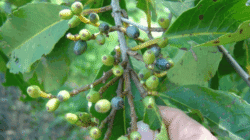
Lemon plant flowers grow in the axils of the leaves, have triangular stems, and are compound flowers. The length of the flowers reaches 1.5 cm and is green. On the flower crown, the shape resembles a star and is also green.
The stamens are 1.5 cm in size with yellow anthers and are kidney-shaped. The stem of the flower pistil is cylindrical measuring 1 cm.
The head of the pistil is round and yellow. Then, the crown of the flower has a white combined with yellow color with a star shape and consists of five strands.
5. Morphology of Lemon Plant Fruit
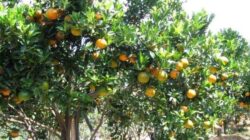
In general, lemon fruit has a dark yellow color, with thick flesh and a shiny skin surface.
However, the dark yellow color will become pale if it is a little too ripe. The skin of a lemon has a rough texture, is round, the base is quite prominent, and contains essential oils. The length of the fruit usually reaches 8 cm and has a skin thickness of up to 0.7 cm.
The flesh of the fruit has a slightly reddish yellow color with a fruit juice content of 5% citric acid and a pH of 3.
Inside the fruit of the lemon plant, there are seeds that are white, round like an egg, and wrinkled. The number of seeds in a lemon can be said to be quite large, reaching 15 seeds.
Conclusion
Lemon is a plant that belongs to the Rutaceae family with the Latin name Citrus Limon. This plant is found on the Asian continent. Lemons contain high levels of vitamin C and are widely used for health.
The lemon plant has a taproot, the stem of this plant is woody with a round and thorny shape, the lemon leaf is a single leaf with an oval shape, the lemon flower is a green compound flower while the lemon fruit is generally yellow and has thick flesh.
All content and articles published on DomainJava.com are provided solely for informational and educational purposes. We strive to present accurate, relevant, and useful information, but it is not intended to violate any laws, policies, or guidelines. Any use of the information contained in the article Classification and Morphology of Lemon Plants is entirely the responsibility of the reader.