List of contents
Do you know the Classification and Morphology of Jatropha Plants? For those of you who are plant lovers, perhaps you are already familiar with castor oil plants.
However, if you are still a beginner or don’t know what jatropha plants are, then here we will explain it.
The jatropha plant is a plant that can grow in various regions, where the jatropha plant is one of the wild plants.
This jatropha plant is capable of producing oil which is processed as fuel or a substitute for petroleum. So, for this wonderful opportunity, here we will discuss the classification along with the morphology of castor oil plants.
What is the classification and morphology of this jatropha plant? Just take a look at the review below.
Also Read: How to Cultivate Jatropha Plants
Classification of Jatropha Plants
The first thing here we will discuss is the classification of castor oil plants. Generally, the classification of castor oil plants is very unique and interesting.
So what is the classification of this castor plant? You can save the discussion that we have prepared as below.
- Kingdom : Plantae
- Sub Kingdom : Viridiplantae
- Infra Kingdom : Streptophyta
- Divisions: Tracheophyta
- Sub Division: Spermatophytina
- Class: Magnoliopsida
- Sub Class: Rosidae
- Order: Malpighiales
- Famili : Euphorbiaceae
- Genus : Jatropha L.
- Species : Jatropha curcas L.
Morphology of Jatropha Plants
After you have listened to the classification of castor oil plants, then you will next read the morphology of this castor oil plant which includes leaves, flowers, stems, fruit and seeds. What are you waiting for, just take a look at the review that we have written, here is the review.
1. Leaves
Jatropha is a shrub type plant with a height of around 1 to 7 meters. The leaf morphology of this jatropha plant has a curved leaf shape with three or five corners.
In general, the leaves of this jatropha plant are quite wide and round in the shape of an egg and can be estimated to reach a length of around 5 to 15 cm.
Please note that the leaf veins of this jatropha plant are fingered, and the leaves are connected to leaf stalks with a size of around 4 to 15 cm.
2. Flowers
The flowers of this jatropha plant have a panicle shape and are one of the compound flowers. The flowers of this jatropha plant are greenish yellow and unisexual and monoecious or usually referred to as pistils and stamens on one plant. The flowers consist of 5 petals with an oval shape and are approximately 4 mm long.
In general, the stamens of the castor plant flowers are at the base and are yellow in color. The pistil stalk is short and has a green color and the stigma looks curved out with a yellow color too.
The flowers of this jatropha plant have 5 crowns with a purplish color support. On each sign there are approximately 15 flowers and the proportion of female flowers can reach 4 to 5 times that of male flowers.
The female and male flowers are arranged in a series that has formed a cup and grows in the leaf axils or stem tips.
Jatropha plants have unisexual flowers and are included in the monoecious plant group. However, hermaphroditic flowers often appear and have a yellowish green color.
3. Child
The stem of this jatropha plant has a cylindrical shape. If this stem is injured it will produce sap.
It should be noted that this stem has a function as a branching system to support expansion in the field of photosynthesis. This is the main transport of air, water and organic materials as photosynthate and nutrients.
4. Fruit
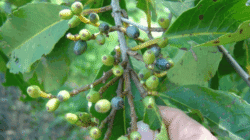
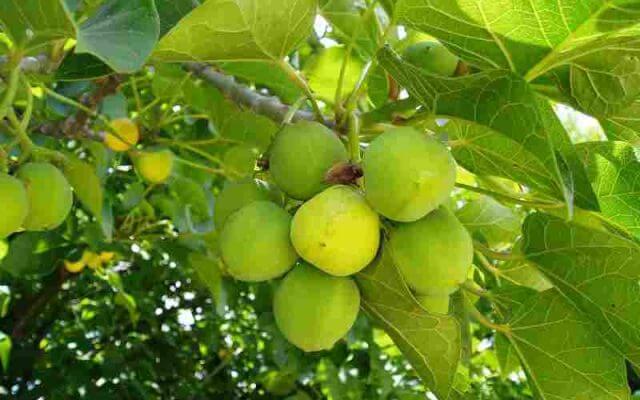
The morphology of this jatropha fruit has an egg-shaped shape and a diameter ranging from 2 to 4 cm. It is estimated that the length of the fruit of this castor plant reaches 2 cm and the width can reach 1 cm.
Generally, the fruit of this jatropha plant has two colors according to its growth. If the castor fruit is still ripe, the color will look green, while the ripe castor fruit has a brownish to blackish color.
You should know that this castor fruit has 3 chambers and in each chamber there is 1 seed, and this means that each castor fruit has 3 seeds.
5. Seeds
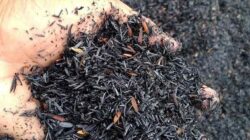
The seeds of this jatropha plant have an oval shape and are accompanied by a slightly blackish brown color. The size of the seeds of this jatropha plant is 2 cm long with a thickness of up to 1 cm and is accompanied by a weight ranging from 0.4 to 0.6 grams for each seed.
Conclusion
Jatropha is a plant that belongs to the Euphorbiaceae family with the Latin name Jatropha curcas L. This plant is a wild plant and is able to live in various areas, this plant is able to produce oil and can be processed into fuel.
The leaves of the jatropha plant are curved and have three or five corners, the flowers of this plant are compound flowers with a greenish yellow color, the stem is cylindrical and will release sap if it is injured, the jatropha fruit is egg-shaped, while the seeds are oval and oval.
Also Read: Conditions for Growing Jatropha Plants
All content and articles published on DomainJava.com are provided solely for informational and educational purposes. We strive to present accurate, relevant, and useful information, but it is not intended to violate any laws, policies, or guidelines. Any use of the information contained in the article Classification and Morphology of Jatropha Plants is entirely the responsibility of the reader.