List of contents
One of the causes of the decline in the quality and quantity of citrus plant productivity is the presence of pest attacks and citrus plant diseases.
One of the most dangerous diseases attacking citrus plants is blight Citrus Vein Phloem Degeneration or better known as CVPD.
As a result of this disease, orange plants can die, causing losses to farmers.
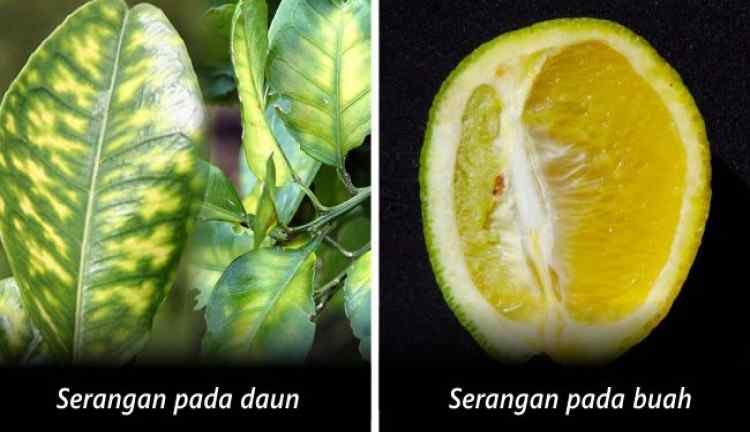
As a result of the CVPD disease, the orange plants’ leaves turn yellow, the sieve vessels are damaged so that the growth of the orange plants is hampered and the orange plants will slowly die.
The cause is bacteria Asian freebacker which lives only on Phloem tissue.
Due to this attack, phloem cells degenerate and the citrus plant’s absorption of nutrients is hampered.
This disease, which can spread to all parts of the orange plant, can be found in all oranges in Indonesia.
The spread of CVPD disease from area 1 to other areas is by inserting infected orange plants into land with uninfected orange plants.
Meanwhile, the spread of CVPD to other plants uses the Diaphorina citri vector or uses infected eye patch shoots.
How to Control CVPD Disease on Citrus Plants
In citrus cultivation, this disease can cause plants to fail to harvest and inhibit their growth. The following are ways to control CVPD disease on citrus plants:
1. Healthy Seeds
Plant orange fruit with healthy seeds that have a disease-free certificate and clear varieties that can be obtained from breeding orange seeds – registered orange seeds at the Seed Quality Monitoring and Certification Center.
You can reproduce tissue culture that can produce disease-free oranges, so that in the future disease-free orange seedlings can be obtained.
2. Treat Jumping Fleas or Diaphorina Citri
The insect that transmits CVPD disease is the psyllid or Diaphorina citri, to treat it do:
- Use natural enemies such as red beetles
- Use a yellow trap which can be installed by hanging ½ from the height of the orange tree and placed between the orange trees. Using this method is expected to attract psyllids in the orange plantation area.
- Use chemical insecticides.
3. Use insecticide
You can use contact insecticides with the active ingredients cypermethrin or dimethoate.
4. Stem Sweeping
Sweep the main trunk of the orange tree when it enters the budding phase using a systemic insecticide containing the active ingredient abamectin or imedachloroid without dilution.
This process also occurs when the psyllid population increases. Sweeping method:
- Clean the main stem with a rag for example. Clean 10 – 20 cm from the area of the grafting eye using a brush around the stem whose width is the same as the diameter of the stem.
- Sprinkle water on the stems that have been swept, especially when the dry season arrives, this aims to speed up the action of the insecticide that has been applied through the sweep.
Characteristics of CVPD attacks
- Citrus leaves will be striped in an irregular, asymmetrical pattern between the right and left half of the leaf.
- The leaves experience stunted growth, so the leaves become stiff, smaller, tapered and the leaves even face upwards.
- The fruit of an infected orange tree will appear asymmetrical when opened, the seeds are not pithy with brown seed tips.
- When the initial seedlings are attacked by CVPD disease, their growth will be unhealthy from the first time they grow.
Ways of prevention and control
- Procurement of disease free seeds
- Use the antibiotic oxytetracycline
- Carry out quarantine according to Minister of Agriculture Decree No. 129/kpts/mu/3/1982 which contains a prohibition on transporting citrus plants from endemic areas to areas free from PVCD disease
- Provide regular irrigation and fertilization
- Carry out area mapping against CVPD attacks
That’s the discussion this time regarding How to Control CVPD Disease on Citrus Plants. Hopefully it can be useful.
All content and articles published on DomainJava.com are provided solely for informational and educational purposes. We strive to present accurate, relevant, and useful information, but it is not intended to violate any laws, policies, or guidelines. Any use of the information contained in the article How to Control CVPD Disease on Citrus Plants is entirely the responsibility of the reader.