List of contents
Do you know how to make husk charcoal? Husk is the skin of the grain that is released during the rice milling process, it is dry, light, scaly, and of course cannot be eaten.
Approximately 20 – 30% of the rice milling process will be thrown away in the form of husks. In rice production areas, husks are often seen piled up in rice milling areas. In some places, husks are even considered waste.
Local communities often use the husks from rice waste to make useful materials that have added value and selling value, namely making husk charcoal.
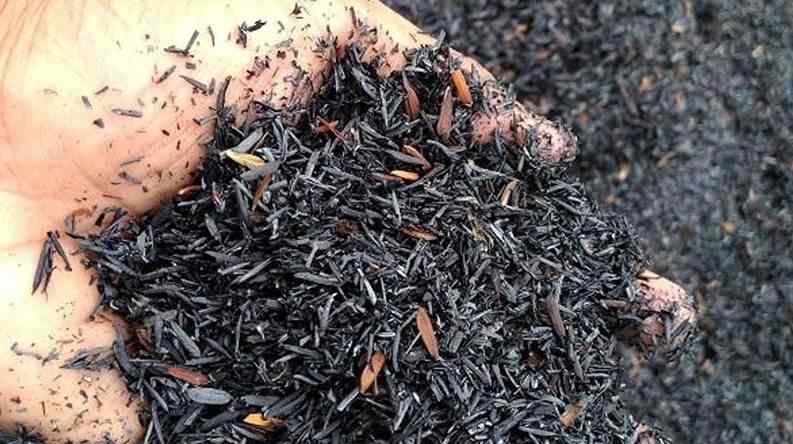
Husk charcoal is made through incomplete combustion or partial combustion of rice husks, so that the end result of burning is charcoal (not ash).
Husk charcoal is an important material that can be used as a raw material for agriculture and industrial needs. Farmers use it for making compost, loosening the soil, regulating soil pH under certain conditions, planting media and seeding media.
Consumers will always be there, even husk charcoal is always available in agricultural shops, so there is no need to be afraid of experiencing difficulties in marketing it.
Advantages of Chaff Charcoal as Planting Media
The following are the advantages of husk charcoal as a planting medium, namely:
- Has a relatively neutral pH.
- It has long durability, in general it can last up to 1 year.
- The manufacturing process is very easy and fast.
- Has a light weight.
- It is known to be more sterile from pathogens and fungi.
- In terms of price, it is relatively much cheaper.
- The availability of raw materials for manufacturing is quite abundant.
Also Read: Benefits of SP36 Fertilizer
How to Make Husk Charcoal
There are two important stages in making it, namely the stage of making the burning tool and the stage of the rice husk burning process. Here’s more about how to make husk charcoal:
1. Make a Burning Tool
- Use barrels, cylinders, or drums made of iron, steel, aluminum, or metal that is fire resistant. The ideal cylinder size required is approximately 20 liters. Remove one of the covers (base or roof) from the cylinder.
- In the part of one of the covers (base or roof) of the cylinder that is not removed, make a circular hole with a diameter of 10 cm. The hole is made at the center point or center diameter of the cylinder.
- Make holes using nails in the cylinder wall (hole diameter approximately 0.5 cm), with a distance of 2 – 3 cm between one hole and another. The hole functions to remove heat from the fuel to the pile of rice husks without the need to burn the husks directly.
- As a note, the sharp part of the holes must point or face outward, similar to grated coconut. This is intended so that the flames stick out.
- Make a 1 cm long zinc pipe with a diameter of approximately 10 cm. Insert the zinc pipe into the hole that has been made in one of the covers (base or roof) of the cylinder which will function as a chimney for the combustion chamber in the main cylinder. Attach the zinc pipe by welding, so that the pipe can stand perpendicular to the cylinder. Or you can use another method, namely placing the zinc pipe in the hole in the cylinder, propping it with nails and tying it with iron wire so that the zinc pipe can stand upright.
2. Combustion Process
- Choose a location for burning husks that is far from housing, settlements, or roads, because the process of burning rice husks will produce thick smoke. The base for the burning place should be made of a hard floor that is heat resistant, or you can use a zinc plate as a burning base. This can also make it easier to collect husk charcoal.
- Make a campfire the size of a cylinder. Bonfire fuel can use paper, old newspapers, firewood, or dry leaves. Light a fire, then cover the fire using the cylinder that was given the chimney.
- Fill the cylinder combustion chamber (where the fire is already burning) with several sacks of rice husks. The hoarding is carried out in the form of a mountain upwards with a height of approximately 1 meter, with the top of the heap being a burning chimney that shoots out.
- After waiting 20 to 30 minutes, or after the top of the pile of husks looks black, raise the husks that are still brown (below) towards the top. Do this repeatedly until all the rice husks are perfectly black.
- When all the husks have turned completely black, sprinkle them evenly with water. Watering is done to stop the ongoing burning process. If the burning process is not stopped quickly, it will turn into ash.
- After watering and the temperature has dropped, dismantle the mountainous pile, then dry. Then, put the dried husk charcoal into sacks and store the sacks in a dry place.
Benefits of Husk Charcoal
Apart from being used by farmers to loosen the soil, as a compost material and as a seeding medium, it turns out it has many other benefits. Hull charcoal is much needed as a growing medium for ornamental plants.
The advantages offered are that it is light in weight and easy to clean from plant roots, therefore it will simplify the process of distributing ornamental plants. Light, sterile, and has good porosity, husk charcoal can also be used as a hydroponic medium. Hydroponic plants that can use husk charcoal are tomatoes, cucumbers and peppers.
That is the explanation and review of how to make husk charcoal from rice plants. Hope it is useful.
Also Read: Understanding Urea Fertilizer
All content and articles published on DomainJava.com are provided solely for informational and educational purposes. We strive to present accurate, relevant, and useful information, but it is not intended to violate any laws, policies, or guidelines. Any use of the information contained in the article 11 Ways to Make Chaff Charcoal Easily is entirely the responsibility of the reader.